
A straight board brought into a warm shop can turn into an arched ski or a corkscrew within days. This movement frustrates woodworkers because it seems unpredictable. One day the lumber lies flat on the workbench, and the next morning a corner lifts into the air. Wood is not an inert plastic or metal. It behaves more like a bundle of microscopic plant tissues that respond to the surrounding air long after the tree has been cut into planks.
Wood warps because it constantly exchanges moisture with the environment. When the air is wet, the wood swells. When the air is dry, the wood shrinks. Warping occurs when this swelling or shrinking happens unevenly across different parts of the same board. Understanding the internal physics of tree growth allows you to predict this movement, arrange your stock properly, and build furniture that stays flat for decades.
What happens inside wood cells when humidity shifts?
Why does wood shrink at all? To understand the answer, imagine a dry kitchen sponge. When wet, the cellulose walls of the sponge absorb water, swell up, and push outward. Wood behaves in the exact same manner. A living tree is full of liquid, which exists in two forms: free water and bound water. Free water sits inside the open cavities of the wood cells, like water held inside a bucket. Bound water is chemically trapped inside the cell walls themselves.
When a tree is felled, the free water leaves first. This process does not change the physical dimensions of the lumber. Once the cell cavities are empty, the wood reaches what arborists and lumber millers call the fiber saturation point. In most species, this happens when the wood reaches roughly 28 percent moisture content. Only when the wood dries past this point does the bound water begin to evaporate from the cell walls. As moisture leaves the cell walls, the cellulose fibers draw closer together, causing the entire board to shrink.
The problem is that a board never loses or gains moisture evenly across its surface. If you lay a wide plank flat on a damp concrete floor, the bottom face absorbs moisture from the concrete while the top face loses moisture to the dry room air. The bottom cells swell while the top cells contract. Because the two surfaces are locked together within the same physical piece of wood, the board is forced to bend upward at the edges to relieve the internal stress.
The rate of this movement is determined by relative humidity, which is the amount of water vapor present in the air compared to the maximum amount the air can hold at that specific temperature. When relative humidity stays stable, wood eventually reaches equilibrium moisture content, meaning it neither gains nor sheds moisture. Until it reaches that point, the cellular structure remains in a dynamic state of pull and push.
The three types of warpage: cup, bow, and twist
When lumber moves, it distorts along predictable geometric axes. Woodworkers divide these distortions into three main categories: cup, bow, and twist. Identifying the exact nature of the distortion is the first step toward correcting or working around it.
Cupping occurs across the width of a board. If you look at the end grain of a cupped plank, the edges curve upward or downward like a shallow trough or canoe. Cupping almost always traces back to the curve of the growth rings. Wood shrinks significantly more along the direction of its growth rings than it does across them. As a result, the rings attempt to straighten out as the plank dries, lifting the outer edges away from the center of the tree.
Bowing occurs along the length of the board on its flat face. Imagine a long board resting on two sawhorses; if the middle sags toward the floor or arches toward the ceiling, the board is bowed. This happens when the longitudinal wood fibers on one face dry and contract faster than the fibers on the opposing face, often due to sunlight shining on one side of a stack or uneven airflow in a storage rack.
Twisting is the most difficult distortion to correct. A twisted board resembles a propeller: three corners might sit flat on a table, but the fourth corner sticks up into the air. Twisting usually happens in boards cut from trees that grew with spiral grain, or in trees that leaned on hillsides and developed uneven reaction wood. As the spiral fibers dry, they torque the board diagonally.
| Distortion Type | Axis of Movement | Primary Cause | Visual Indicator |
|---|---|---|---|
| Cup | Across the width (edge to edge) | Unequal shrinkage along growth rings | Plank curves like a shallow bowl or trough |
| Bow | Along the length (face curve) | Differential drying rate between top and bottom faces | Plank arches like a traditional archery bow |
| Twist | Diagonally across both length and width | Spiral grain or uneven internal tension release | Opposite diagonal corners refuse to sit on the same plane |
Why flat-sawn lumber moves more than quarter-sawn stock
How a log is sliced at the sawmill directly dictates how much the resulting lumber will move in your shop. The two most common milling cuts are flat-sawn (often called plain-sawn) and quarter-sawn. The difference between them comes down to the angle at which the growth rings intersect the face of the board.
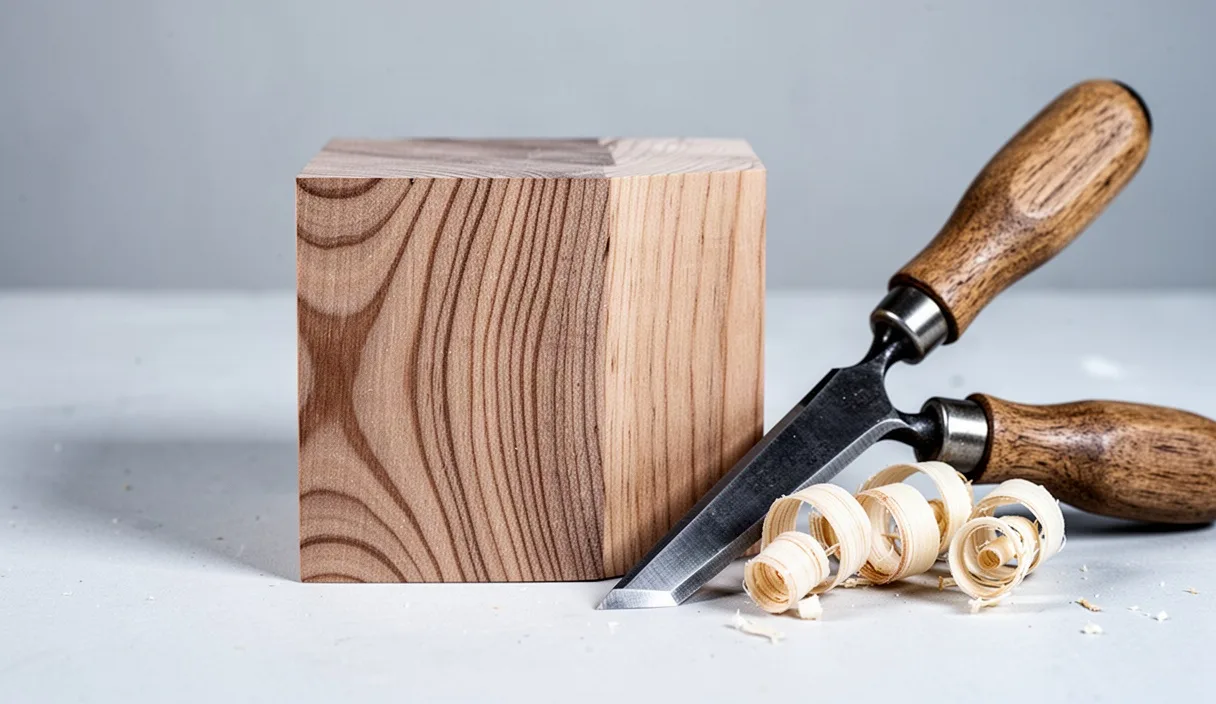
Wood does not shrink at an equal rate in every direction. It shrinks by a negligible amount along its length, usually less than 0.2 percent from green to oven-dry. Across the growth rings (the radial direction), shrinkage is modest. Along the growth rings (the tangential direction), shrinkage is roughly twice as high. Flat-sawn lumber is cut tangent to the annual growth rings. When you examine the end grain of a flat-sawn board, the rings appear as wide arches, running nearly parallel to the wide faces of the board.
Because the growth rings run along the face in flat-sawn wood, the tangential shrinkage works directly against the width of the plank. The bark side of the board contains longer annual ring segments than the heartwood side. As the board dries, the bark side shrinks more than the heartwood side, causing the board to cup severely toward the bark. In contrast, quarter-sawn boards are cut with the growth rings running nearly perpendicular to the wide faces, typically between 60 and 90 degrees. Any shrinkage occurs primarily through the thickness of the board rather than across its width.
| Species | Radial Shrinkage (Quarter-Sawn) | Tangential Shrinkage (Flat-Sawn) | Movement Ratio |
|---|---|---|---|
| Northern Red Oak | 4.0 percent | 8.6 percent | 2.15 to 1 |
| Sugar Maple | 4.8 percent | 9.9 percent | 2.06 to 1 |
| Black Walnut | 5.5 percent | 7.8 percent | 1.41 to 1 |
| White Pine | 2.1 percent | 6.1 percent | 2.90 to 1 |
Quarter-sawn boards remain remarkably flat over seasonal humidity changes because their faces shrink uniformly. If you are building wide drawer bottoms, large tabletop panels, or tightly fitted door frames, quarter-sawn stock provides significantly higher stability than flat-sawn stock.
Stacking with stickers for balanced airflow
If you store freshly purchased boards flat on top of one another in a solid pile, the boards on the exterior will dry quickly, while the boards in the center stay moist. The top face of the uppermost board will dry faster than its bottom face, causing immediate cupping. To prevent this, woodworkers use a technique called stickering.
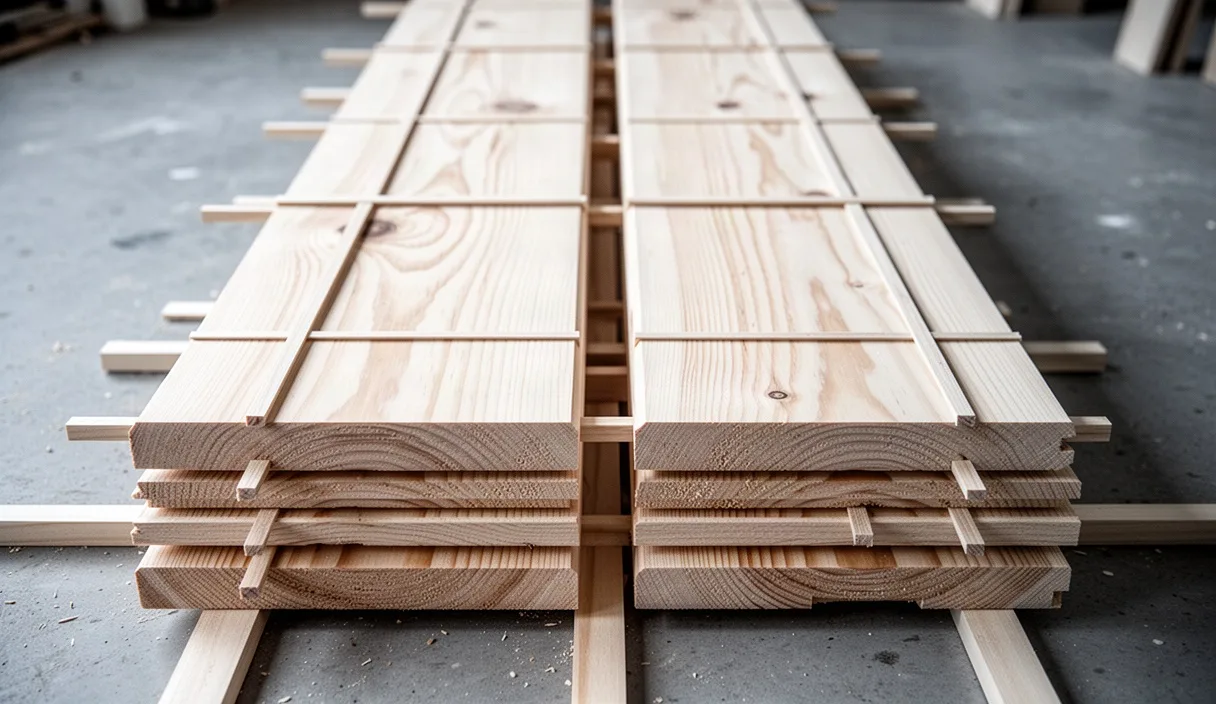
Stickers are uniform, dry strips of scrap wood placed between layers of lumber to create an air gap. This gap allows air to circulate around all four sides of every board, ensuring that moisture evaporates from the top and bottom faces at the same speed. Here is how to create a proper stickered stack:
- Establish a flat, level base: Lay down support timbers or thick blocks spaced 16 inches apart. If your support base has dips or rises, the lumber resting on it will slowly conform to those dips and dry with a permanent bow.
- Select uniform spacer strips: Cut your stickers from dry, clean wood. Softwoods like pine or fir work well. Every sticker must be identical in thickness, typically 0.75 inches thick by 1 inch wide. Using mismatched scrap strips of different thicknesses will introduce bends into the stack.
- Align stickers vertically: Lay down your first course of boards, then place a sticker directly over every base support timber. When adding subsequent layers of boards, place the new stickers directly in line vertically above the stickers below them. If a sticker is offset by even three or four inches, the weight of the lumber above will press down on an unsupported span and bend the board underneath.
- Space stickers consistently: For hard hardwoods like oak, hard maple, and hickory, keep stickers no more than 16 inches apart. For softer hardwoods like walnut or soft maple, and for woods prone to twisting, reduce the spacing to 12 inches.
- Apply top weight: The uppermost boards in a stack do not have the weight of other lumber holding them flat. Place a sheet of rough plywood on top of the final layer of stickers, and load it with concrete blocks, scrap iron, or heavy bags of sand. This downward force restrains the upper boards as they shed moisture.
Checking moisture levels before cutting joinery
A frequent cause of failed joints is milling wood that has not reached moisture equilibrium with the room where the finished piece will live. If you buy lumber from an unheated storage shed and immediately cut mortise-and-tenon joints in a heated, dry workshop, the wood will shrink after the joints are cut. Tenons will become loose, panels will rattle in their grooves, and glued joints will split under tension.
Do not guess moisture content by touch or weight. Use a moisture meter to measure the wood accurately. There are two primary types of meters available to woodworkers:
- Pin-type meters: These use two sharp metal probes that you press into the wood. The meter passes an electrical current between the pins and measures the electrical resistance of the wood fibers. Because water conducts electricity, higher moisture creates lower resistance. Pin meters leave small holes in the surface, but they allow you to take readings at different depths by pushing the pins deeper into the core.
- Pinless meters: These meters use an electromagnetic sensor pad placed flat against the wood face. They measure the dielectric properties of the plank without puncturing the surface. Pinless meters work well for finished stock or expensive hardwoods where surface holes are unacceptable, though they require you to input the specific gravity of the wood species for accurate results.
For interior furniture, lumber should ideally sit between 6 percent and 8 percent moisture content before you make final cuts. Outdoor furniture, such as garden benches or picnic tables, can be built from stock at 12 percent to 14 percent moisture content, because exterior humidity is naturally higher. When testing a board, take readings in the center of the face, not just at the ends, because the end grain dries much faster than the middle.
If you purchase rough lumber, bring it into your shop and let it acclimate for at least two weeks before jointing and planing. If the wood has a moisture reading that differs from your shop environment by more than 3 percentage points, wait until the readings stabilize. For valuable architectural projects or extensive flooring installations where structural movement poses a severe risk, consulting a professional lumber dry-kiln operator or an architectural wood certification inspector is advisable.
Common mistakes
Even experienced builders sometimes ruin good lumber by rushing preparation or ignoring storage fundamentals. The following habits cause the majority of unforced warping issues in the shop:
- Leaning boards against shop walls: Storing lumber vertically against a wall might save floor space, but it invites bowing. The bottom of the board rests near the cold floor where relative humidity is higher, while the top sits in warmer, drier air near the ceiling. Gravity also causes the plank to sag under its own weight over time.
- Finishing only the visible face: When building a tabletop, some woodworkers apply four coats of varnish to the top surface and leave the underside raw wood. The raw underside absorbs and releases room humidity freely throughout the year, while the finished top face cannot. The resulting imbalance creates continuous, severe cupping that will pull pocket screws or tabletop fasteners completely out of their mountings.
- Milling to final dimensions in one pass: Rough lumber contains internal tensions from the drying process. If you take a rough 1-inch board and immediately plane it down to its final 0.75-inch thickness in a single afternoon, the newly exposed core will release stress and warp overnight. Always rough-mill your stock slightly oversized, allow it to rest on stickers for 24 to 48 hours to relieve stress, and then make the final light smoothing cuts.
- Ignoring seasonal panel expansion in frames: Solid wood raised panels inside cabinet doors must float freely in their frame grooves. If you glue the panel into the frame, or if you apply thick finish that glues the panel into the corners, the panel cannot expand across its width during summer. It will either buckle the frame joints outward or crack down the middle during winter.
Practical next steps
Managing wood movement is not about forcing the material into submission through heavy mechanical fasteners; it is about working in harmony with its cellular structure. Begin by purchasing an accurate moisture meter. Before you plane your next board, measure the lumber and measure several finished pieces of furniture inside your home to understand the baseline moisture level of your living space.
Design your projects with seasonal movement in mind. Use slotted screw holes or traditional tabletop fasteners (such as figure-eight clips or wooden z-buttons) that allow wide tops to slide across their support rails as relative humidity rises and falls. When gluing up wide panels from flat-sawn lumber, alternate the growth rings up and down from one board to the next. While this does not stop individual boards from moving, it prevents the entire tabletop from curling into one large, uniform trough, transforming a severe structural issue into subtle, manageable waves.